Research & Development
Examples of Analysis Items

Compression/Tensile Strength Test, Fracture/Crushing Strength Test, Creep Test, Texture Profile, etc.
The wide range of physical property data obtained through various tests using
a Sun Rheometer enables detailed quantification and visualization
of sample characteristics and behaviors, supporting research, development, and quality control across diverse fields.
Examples of Analysis Items
Compression/Tensile Strength Test, Fracture/Crushing Strength Test, Creep Test, Texture Profile, etc.
 Compression/Tensile Strength Test
A technique that measures the force exerted on a sample during compression or tension. It is one of the most widely used methods in material testing and enables detailed evaluation of deformation behavior.
Observing stress variations and maximum stress during sample compression allows for detailed analysis of mechanical properties. It is suitable for evaluating the physical properties of various samples.
Measurement Example
Stress transition and maximum stress up to 60% compression of the sample
The stress applied at the point of sample failure. Used as an indicator of sample durability.
Measurement Example
The load applied until the sample is destroyed, such as stretching and cutting noodles or slicing vegetables.
The energy required during compression or tension (integrated value). It calculates the energy needed until fracture or maximum stress, or within a user-defined range.
Measurement Example
The energy required for one cycle of mastication.
A physical quantity used to evaluate the elasticity of a sample. Elasticity can be calculated from deformation near the start of compression.
Measurement Example
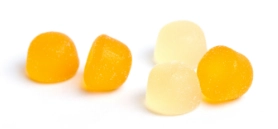
The resistance to deformation when crushing a gummy candy (elasticity perception).
Target Measurement Samples
 Stress Relaxation Test
A measurement method that observes the decrease in force while maintaining a constant deformation in the sample. Ideal for evaluating the viscosity and elasticity of food products.
A physical quantity representing the resistance to the rate of deformation. Suitable for evaluating 'stickiness'.
Example Measurement
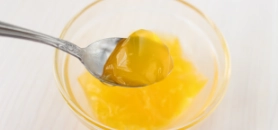
The resistance to flow in a gel-like sample.
A physical quantity representing resistance to deformation. Measures the contribution of reversible, spring-like properties in a sample.
Measurement Example
Elasticity of a gel-like sample.
An item used to evaluate the speed of deformation in a sample. Calculated as the ratio of viscosity to elasticity.
Measurement Example
Comparison of the time taken for different samples to reach a specific level of deformation.
The amount of deformation remaining in a sample after releasing the applied force. Allows observation of irreversible deformation.
Measurement Example
Residual deformation after compressing and releasing a marshmallow-like sample.
Target Measurement Samples
 Creep Test
A measurement method adapted from widely used techniques for evaluating the deformation characteristics of metal materials. Suitable for assessing the viscoelasticity of samples with slow deformation rates.
For soft materials (such as food), the process before the application of load cannot be ignored, making stress relaxation testing more appropriate for similar viscoelastic evaluations.
A physical quantity representing resistance to the rate of deformation.
Measurement Example
Contribution of viscosity (material stickiness) in the transient response of long-term deformation in soft plastic, where deformation speed changes over time.
A physical quantity representing resistance to deformation amount.
Measurement Example
Relationship between deformation amount and transient response in long-term deformation of soft plastic.
An item used to evaluate the speed of deformation in a sample. Calculated as the ratio of viscosity to elasticity.
Measurement Example
Comparison of the time taken for different samples to reach a specific level of deformation.
Target Measurement Samples
 Viscoelastic Evaluation Test (NRCC Visco-PRO)
A suitable method for non-destructive measurement of the viscoelastic properties of non-Newtonian fluids to gel-like samples, where viscoelasticity changes with deformation speed.
A physical quantity representing resistance to the rate of deformation. Suitable for evaluating 'stickiness'.
Measurement Example
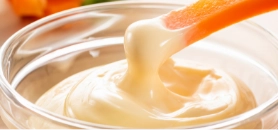
Measurement of the smoothness (flowability) of mayonnaise.
A physical quantity representing resistance to deformation amount. Measures the contribution of reversible, spring-like properties in a sample.
Measurement Example
Evaluation of the shape-retention property of mayonnaise.
By varying the deformation speed during measurement, viscoelastic responses over a broad range can be evaluated.
Measurement Example
Evaluation of viscoelasticity at different flow speeds, such as when passing through the mouth and throat.
Target Measurement Samples
Examples of Analysis Items

Compression/Tensile Strength Test, Jelly Strength Test, Bending Test, Probe Tack Test, etc.
 Fracture/Crushing Strength Test
A test method that analyzes the force applied to a sample during cutting, fracturing, or crushing. Suitable for strength testing and brittleness evaluation.
The maximum stress obtained during sample compression. Used as an indicator of sample hardness.
Measurement Example
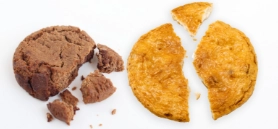
The maximum chewing force required to masticate a snack food.
The stress applied at the point where the sample breaks. Used as an indicator of sample durability.
Measurement Example
The load/stress required to crush a snack food.
The energy required to break or crush a sample. Can be used to calculate the work needed for sample destruction.
Measurement Example
The energy required to crush a snack food through mastication.
Target Measurement Samples
 Bending Test
A test method that measures strength and other properties when bending deformation is applied to a sample. Supports not only JIS K 7171 standard specimens but also samples with different shapes, such as circular cross-sections.
A three-point bending test is conducted on the sample, and the bending stress at the point of fracture is calculated.
Measurement Example
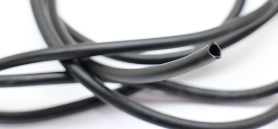
The load/stress required to break a rod-shaped sample in a three-point bending test.
Calculates the strain applied to the sample at the point of fracture.
Measurement Example
The amount of strain applied to a sample before breaking in a three-point bending test.
The ratio of bending strength to strain rate is used to evaluate the elasticity of a sample. (Direct compression or tension testing provides higher theoretical accuracy.)
Measurement Example
Indirect measurement of the elasticity of rod-shaped samples that are difficult to cut or mold, without cutting or compressing them.
Target Measurement Samples

Lipstick

Plastic
 Adhesion Test
A test method that measures the force required to detach the sample from a contact surface, used to evaluate its adhesive properties.
Measures the maximum force required to peel off a contacted surface.
Measurement Example
Measurement of the adhesiveness of a medical patch on its adhesive surface.
Calculates the energy required to completely peel off a contacted surface.
Measurement Example
The amount of work applied to peel off a medical patch.
Target Measurement Samples
Examples of Analysis Items
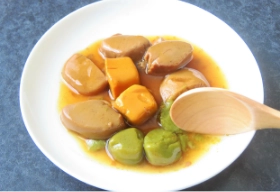
Food for Dysphagia Patients, Universal Design Food, etc.
 Testing for Food for Dysphagia Patients / Universal Design Food
A standard test evaluating swallowing ease required for nursing and medical food products, along with approval criteria.
A standard set by the Japanese Consumer Affairs Agency for medical food approval, classifying approval criteria based on hardness, adhesiveness, and cohesiveness.
A standard set by the Japan Care Food Association for nursing food, classifying samples based on hardness into categories such as 'Easy to Chew' and 'Can be Crushed by Gums'.
Target Measurement Samples
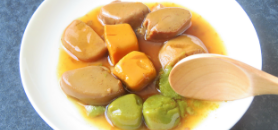
Nursing and Medical Food Products
 Jelly Strength Test
A standardized test for measuring the hardness of gelatin and similar substances, defined by JIS K6503 and the Japanese Pharmacopoeia (Bloom Value).
Uses a specified container and adapter (common in both JIS and the Japanese Pharmacopoeia). The adapter compresses the jelly inside the container, measuring the maximum load.
Target Measurement Samples