Food
Examples of Target Objects
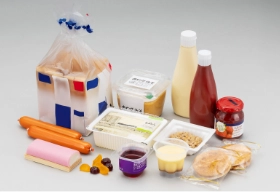
Jelly, Konjac, Tofu, Kamaboko, Beans, Noodles, Confectionery, Bread, Ham, Sausage, Cheese, Butter, Yogurt, Rice, Fruits, Vegetables, Ketchup, Mayonnaise, Jam, etc.
We measure and visualize the properties of diverse samples from multiple perspectives.
If you're unsure about the most suitable measurement method for your material, feel free to contact us for advice.
Examples of Target Objects
Jelly, Konjac, Tofu, Kamaboko, Beans, Noodles, Confectionery, Bread, Ham, Sausage, Cheese, Butter, Yogurt, Rice, Fruits, Vegetables, Ketchup, Mayonnaise, Jam, etc.
For brittle food samples like cookies and rice crackers, breaking stress-the force required to break them-and crispness (crunchiness) derived from minor force fluctuations during breaking serve as quality indicators. These foods readily absorb moisture from their surroundings, significantly altering their texture, making it crucial to monitor physical property changes under controlled humidity conditions using a constant-humidity chamber.

Typical Testing Methods
Key Measurement Points
In evaluating the physical properties of cookies and rice crackers, breaking stress is the primary focus. Compression and tensile tests quantify the force required to deform and break the product, while fracture/crushing strength tests analyze crispness through minor force fluctuations. Furthermore, tracking property changes under constant humidity conditions enables quality evaluation that considers humidity effects.
For elastic samples like gummies and marshmallows (gels), evaluating elasticity—how well they return to their original shape after biting—is essential, along with stress relaxation tests that examine how stress decreases when a certain deformation is maintained. In gummies, where viscoelasticity is complex, both initial chew resistance and mid-chew softness can be quantitatively assessed.

Typical Testing Methods
Key Measurement Points
In evaluating the physical properties of gummies and marshmallows, hardness, permanent plasticity (the extent of deformation remaining after one bite), and elasticity are measured using compression tests, stress relaxation tests, and fracture strength tests to determine the force required to bite through them. This allows observation of deformation during mastication. Additionally, replicating the oral environment by applying artificial saliva when necessary can be an effective approach.
For semi-fluid condiments like mayonnaise and ketchup (emulsions), analyzing viscoelastic behavior, which includes both viscosity and elasticity, is crucial. Since smoothness and water separation vary depending on emulsification and dispersion states, observing viscosity changes under continuous force (e.g., stirring or scooping with a spoon) helps assess particle dispersion and creaminess.

Typical Testing Methods
Key Measurement Points
In evaluating the physical properties of mayonnaise and ketchup, the focus is on viscoelastic behavior, where both viscosity and elasticity coexist. Stress relaxation tests analyze viscoelasticity and recovery behavior, and tracking changes in viscoelastic properties under different shear rates allows for extensive condition-based property measurements. This clarifies the effects of emulsification state and particle dispersion on smoothness and water separation.
For semi-solid foods like jelly and yogurt that are contained in a package, the balance between hardness, viscosity, and elasticity directly affects texture. The internal structure is formed based on the degree of gelation and the aggregation state of milk proteins, making it important to understand how manufacturing conditions impact physical properties. Since it is difficult to remove these foods from their containers for independent measurement, compression and pull-up tests are usually conducted with the container intact to replicate texture.

Typical Testing Methods
Key Measurement Points
In evaluating the physical properties of jelly and yogurt, compression/tensile tests conducted with the container replicate the balance of hardness, viscosity, and elasticity. Additionally, stress relaxation tests assess internal structural stability, viscoelastic behavior, and permanent plasticity under prolonged deformation. Fracture and crushing strength tests confirm breaking characteristics, accurately capturing spoonability and mouthfeel.
In evaluating cooked rice, compression tests on individual grains or sets of three grains allow for detailed analysis of hardness and elasticity, enabling numerical assessment of cooking conditions and varietal differences. Additionally, performing compression tests while the rice remains sealed in a retort container allows for objective evaluation of its fluffiness after reheating and the degree of quality deterioration over time.

Typical Testing Methods
Key Measurement Points
The widely used one-grain and three-grain compression test methods are effective for evaluating individual rice characteristics, especially for single-variety cooked rice. However, these methods do not account for grain boundary interactions and air pockets that contribute to the overall eating experience of a rice mass. It is also important to note that as the sample size decreases, variability due to individual grain differences increases. For evaluating the eating experience of rice masses, tests conducted on rice cooked in retort containers or on Petri dishes are commonly used.
For processed fish products such as kamaboko and chikuwa, texture quality—referred to as ashi (足) in Japanese quality evaluation—is determined by elasticity, derived from the unique heat-induced coagulation of fish paste, as well as by fracture characteristics under applied load. By analyzing the combined results of elasticity and fracture tests, manufacturers can assess mixing uniformity, production process stability, and detailed texture characteristics related to ashi.

Typical Testing Methods
Key Measurement Points
To evaluate the physical properties of kamaboko and chikuwa, compression, tensile, and stress relaxation tests are used to replicate the elasticity characteristic of heat-coagulated fish paste. In addition, fracture and crushing strength tests reveal breaking behavior under applied load, enabling quantitative assessment of texture uniformity, manufacturing process stability, and the overall quality of ashi (足) in processed fish products.
Examples of Target Objects

Tablets, Capsules, Granules, Ointments, Bandages, Syringes, Needles, etc.
For tablets, evaluating fracture strength—the point at which a tablet breaks under compressive or breaking force—is critical to preventing damage during transport and storage. Understanding mechanical durability also supports formulation optimization, influencing both swallowability and disintegration time. If a tablet is too hard, disintegration may be delayed, which can in turn slow the dissolution of active ingredients. Determining the appropriate hardness balance is therefore essential for effective quality control.

Typical Testing Methods
Key Measurement Points
In tablet physical property evaluation, fracture and crushing strength tests quantify break resistance necessary to prevent damage during transport and storage. Additionally, compression/tensile tests assess overall deformation behavior, providing data to analyze the balance of hardness that influences disintegration speed and active ingredient dissolution.
For capsules, it is essential to evaluate the pull-out strength of the shell connection to prevent breakage. This involves measuring the force required to separate the capsules, providing an indicator of leakage and disintegration risk. The strength and disintegration properties vary depending on the material and filling type, requiring proper measurements from the design stage to ensure safe and effective ingestion. Excessive pull-out resistance can lead to swallowing difficulties or issues with opening the capsule, making balance a crucial factor.

Typical Testing Methods
Key Measurement Points
In capsule physical property evaluation, a specialized capsule pull-out adapter is used in compression/tensile tests to measure the pull-out strength of the shell connection. This quantifies the force required to separate the capsules and evaluates leakage or disintegration risks. By understanding the strength variations due to material and filling differences, it serves as a design indicator for ensuring safe and effective ingestion.
Granules exhibit different physical properties at the single-particle level and as an aggregate, requiring evaluation from both perspectives. At the single-particle level, particle size, shape, and binding force influence dissolution rate and hygroscopicity, while at the aggregate level, inter-particle friction and cohesion affect powder flowability. Understanding these mechanical properties helps stabilize granulation and tableting processes during manufacturing and improves dissolution and dispersion during ingestion. Proper control of particle size and aggregation is directly linked to ingredient uniformity and smooth absorption.

Typical Testing Methods
Key Measurement Points
In the physical evaluation of granulated formulations, compression testing is used to assess particle size, shape, and binding strength in order to clarify the characteristics of both individual granules and their aggregates. Additionally, fracture and crushing strength tests are employed to analyze friction and cohesion within the aggregates, providing valuable data for improving manufacturing stability as well as the dissolution and dispersibility of the product upon administration.
Examples of Target Objects

Lipstick, Lip Balm, Foundation, Cream, etc.
Lipstick and lip balm are semi-solid cosmetics mainly composed of waxes and oils, where application smoothness and break resistance are critical. Bending tests evaluate fracture characteristics under applied force, while penetration tests assess hardness and viscoelasticity during application. Proper formulation and rheological design enable both smooth application and shape stability. Break resistance is particularly sensitive to temperature, and ingredient ratios and crystallization control affect moisture retention, making physical property evaluation essential from the development stage.

Typical Testing Methods
Key Measurement Points
In evaluating the physical properties of lipstick and lip balm, bending tests are conducted to assess application hardness and break resistance. Additionally, compression, penetration, and stress relaxation tests quantify the viscoelasticity and shape stability provided by waxes and oils, examining how temperature changes and ingredient ratios affect moisture retention and application properties.
For foundation products, skin adhesion and the consistency of the finish are key factors in overall performance. However, powder-type foundations are prone to cracking and brittleness due to impact or drying. Fracture behavior is evaluated through compression and bending strength tests, while controlling particle binding and binder composition helps optimize the balance between durability and ease of application. Rheologically, the viscoelasticity of the powder influences cohesion and compressibility, which in turn affect spreadability and tactile friction on the skin. Achieving proper mechanical properties helps prevent powder scattering and contributes to a smooth, even finish.

Typical Testing Methods
Key Measurement Points
In foundation physical property evaluation, fracture and crushing strength tests provide detailed analysis of how powder components behave under impact and drying conditions. Additionally, compression/tensile tests assess the binding state of particles and the effects of binder components, yielding data to enhance durability, uniform application, and spreadability on the skin.
In cream physical property evaluation, viscosity, elasticity, and hardness significantly affect usability. Excessive viscosity makes application difficult, while low viscosity increases the risk of liquefaction and separation, making ingredient ratios and particle dispersion critical. Elasticity represents the ability to return to its original shape after force removal, while hardness affects shape retention in the container and stability during application. Rheological evaluation enables the balance of an easy-to-use texture, application feel, and product longevity.

Typical Testing Methods
Key Measurement Points
In evaluating cream physical properties, a combination of compression/tensile tests, adhesion tests, stress relaxation tests, and viscoelastic evaluation tests is used to clarify complex properties such as viscosity, elasticity, and hardness. These tests quantify the effects of ingredient ratios and particle dispersion on texture, application feel, and shape retention, providing design guidelines for user-friendly products.
Examples of Target Objects

Rubber, Elastomers, Adhesive Tapes, Films, etc.
Rubber and elastomers possess high elasticity, returning to their original shape when external forces are removed. Once the yield point is exceeded, plastic deformation begins, increasing permanent strain. Understanding the elastic modulus and yield point helps optimize impact absorption and durability, enhancing vibration control and sealing material reliability.

Typical Testing Methods
Key Measurement Points
In evaluating the physical properties of rubber and elastomers, compression/tensile tests and stress relaxation tests are conducted to measure the elastic modulus, yield point, and recovery behavior after force removal. Additionally, creep tests analyze permanent deformation under prolonged loading, providing insights into optimizing impact absorption, durability, and vibration control performance.
Adhesion determines the attachment strength to a substrate and affects the resistance felt when peeling. Evaluating elongation is crucial for understanding the elasticity when the tape is stretched. Since adhesive tapes are sensitive to temperature and humidity, mechanical testing under expected usage conditions is necessary. By selecting the appropriate formulation and base material, optimal adhesion and recovery properties can be achieved. These evaluations help improve ease of application and durability.

Typical Testing Methods
Key Measurement Points
In evaluating the physical properties of adhesive tapes, adhesion tests quantify the attachment strength to the substrate and resistance during peeling. Additionally, tensile tests assess tape elongation and elasticity, while considering changes in properties under temperature and humidity variations, ensuring the optimal balance of adhesion and recovery.
Films are thin-layer materials where bending properties and tensile strength significantly affect quality. Bending property evaluation helps assess flexibility and crack resistance, predicting damage risks during processing and use. Tensile tests quantify the load and deformation tolerance, determining the ease of fracture. Utilizing this mechanical data allows optimization of lamination and coating processes, ensuring high reliability in packaging and electronic components.

Typical Testing Methods
Key Measurement Points
In film physical property evaluation, tensile tests quantify tensile strength, deformation resistance, and crack resistance, while bending tests assess bending characteristics. Additionally, stress relaxation tests analyze behavior under sustained deformation, providing reliable data for optimizing lamination and coating processes.


